
For retail chains, quick-service restaurants, gas stations, shopping malls, and brand owners, illuminated signage is essential for visibility and customer recognition. But behind every bright light box is a recurring cost that many businesses underestimate: electricity consumption and long-term maintenance.
Most signage systems run at full brightness all night, even during low-traffic hours when fewer customers are around. Across a single location, this may seem manageable. Across 300, 500, or 1,000 stores, it becomes a major operational expense.
That’s why more signage brands are now adopting time-controlled constant voltage power supplies.
Unlike traditional LED drivers that operate at one fixed output level, a time-controlled power supply automatically reduces brightness during preset hours—typically late evening or overnight—when full illumination is unnecessary. The result is lower energy use, lower heat, longer system lifespan, and better long-term ROI.
If you are evaluating a more efficient power solution for retail signage, light boxes, or chain-store branding projects, this guide explains why time-controlled power supplies are becoming the new standard.
What Is a Time-Controlled Power Supply for Signage?
A time-controlled power supply is a type of constant voltage LED power supply (commonly 12V or 24V) with built-in timing control. It allows the output power to automatically adjust according to a programmed schedule.
For example:
- 6:00 PM – 11:00 PM: 100% brightness
- 11:00 PM – 5:00 AM: reduced brightness / lower power mode
- 5:00 AM – 6:00 PM: standby or daytime logic depending on application
This means signage can stay visible and consistent during peak business hours while consuming less power when customer traffic drops.
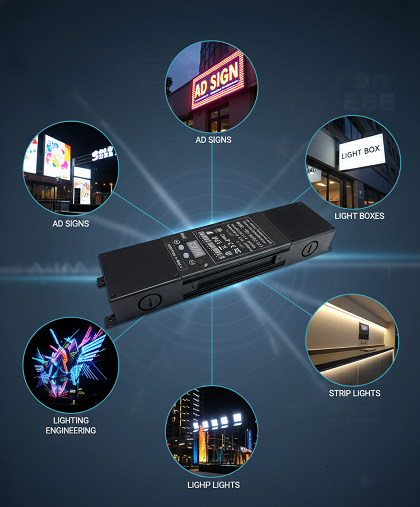
For brands using LED light boxes, channel letters, menu boards, totems, or outdoor branded signs, this is one of the easiest ways to improve efficiency without redesigning the entire lighting system.
Internal Link Suggestion:
Link this section to your product page for time-controlled constant voltage power supplies:
Anchor text: time-controlled constant voltage power supply
Reason 1: Significant Energy Savings Across Multiple Locations
The first and most obvious reason is energy savings.
Traditional signage power systems run at full output all night. But in reality, many stores experience:
- Lower foot traffic after 10 PM
- Reduced customer visibility needs overnight
- Excess brightness during non-peak hours
- Unnecessary power waste across hundreds of sites
With a time-controlled power supply, brands can reduce brightness during late-night periods while maintaining acceptable visibility.
Typical savings range
Depending on runtime and dimming schedule, brands can often reduce electricity usage by:
- 20%–40% per sign
- Higher in applications with long nightly operating hours
- Even greater in large-format signage or multi-module light boxes
For a retail network with hundreds of locations, this often translates into:
- Lower monthly utility costs
- Better project ROI
- Faster payback on signage upgrades
- Easier budgeting for franchise or multi-site rollouts
For large-scale deployments, even a small percentage reduction per sign becomes substantial when multiplied across a national or regional network.
External Link Suggestion:
You can support this section with a general energy-efficiency reference from the U.S. Department of Energy or ENERGY STAR guidelines.
Suggested external anchor text: LED lighting energy efficiency
Reason 2: Lower Brightness at Night Means Lower Internal Heat
LED signage systems don’t just consume electricity—they also generate heat.
When power supplies and LED modules operate at full output for long periods, internal temperature rises. Over time, this heat can accelerate:
- LED lumen depreciation
- Driver aging
- Component fatigue
- Adhesive degradation in light boxes
- Connector and wiring stress
By reducing output during low-demand hours, a time-controlled power supply helps the entire system run cooler.
Why this matters
Lower thermal stress can improve:
- LED module stability
- Driver reliability
- Overall light uniformity over time
- Signage lifespan in sealed or semi-enclosed housings
This is especially important for:
- Outdoor light boxes
- Gas station canopy signage
- Retail fascia signs
- QSR menu boards
- Shopping mall illuminated branding
Reason 3: Longer Lifespan for LED Modules and Power Supplies
Lower heat usually leads to longer component lifespan.
That makes time-controlled power supplies valuable not just for energy reduction, but also for asset protection.
When LED systems run cooler and with reduced nighttime load:
- LED modules often maintain brightness longer
- Drivers experience less thermal stress
- Capacitors and internal components can last longer
- The risk of early failure decreases
- Service intervals may be extended
For brand owners, this matters because signage failures create more than a maintenance issue—they create a brand image issue.
A partially dark sign or uneven light box can affect:
- Store visibility
- Customer perception
- Brand consistency
- Nighttime wayfinding
- Franchise appearance standards
A longer-lasting power solution helps maintain a more uniform visual standard across all locations.
Reason 4: Fewer Service Calls and Lower Maintenance Costs
For multi-location brands, the real cost of signage failure is rarely just the replacement part.
The bigger costs are often:
- Technician dispatch
- Lift or access equipment
- Night service labor
- Traffic or safety restrictions
- Franchise coordination
- Downtime and brand inconsistency
That’s why reducing failure rates is often more valuable than simply buying a lower-cost driver.
A time-controlled power supply can help lower maintenance costs by:
- Reducing thermal overload
- Improving long-term system stability
- Lowering the frequency of component replacements
- Reducing unexpected outages in harsh environments
This is especially valuable in applications such as:
- Retail chains
- Fast food and QSR stores
- Petrol station signage
- Shopping center tenant signage
- Outdoor advertising light boxes
In many projects, the maintenance savings over time can be just as meaningful as the electricity savings.
Reason 5: Easy Retrofit with Standard 12V/24V Light Box Systems
One of the biggest reasons signage brands adopt time-controlled power supplies is that implementation is usually straightforward.
Most systems are based on:
- 12V constant voltage power supplies
- 24V constant voltage power supplies
- Standard LED modules for light boxes or channel letters
That means a time-controlled solution can often be introduced without redesigning the sign structure.
In many cases, there is no need for:
- Replacing LED modules
- Changing sign housings
- Rewiring the entire system
- Modifying the visual design
- Rebuilding the light box
Instead, installers can typically:
- Replace the standard constant voltage driver
- Set the timing schedule
- Test the dimming logic
- Deploy the same configuration across multiple stores
This makes it especially attractive for:
- Chain store rollouts
- Franchise upgrades
- Standardized OEM signage programs
- Energy-saving retrofit projects
Reason 6: Better ROI for Chain-Wide Signage Standardization
For a single sign, the difference may seem small.
For a chain with hundreds of sites, the numbers become much more compelling.
When brands standardize time-controlled power supplies across a network, they gain:
- Predictable energy savings
- Consistent nighttime dimming behavior
- Lower maintenance frequency
- Easier spare-part management
- Standardized installation specifications
- Better long-term lifecycle cost control
This is why time-controlled power supplies are especially attractive for:
- Retail chains
- QSR / restaurant brands
- Convenience store networks
- Petrol station operators
- Shopping mall signage contractors
- National advertising display systems
Instead of treating signage as a fixed electricity expense, brands can turn it into a managed efficiency system.
That shift is exactly why more specifiers, sign manufacturers, and brand owners are moving away from basic fixed-output drivers.
Best Applications for Time-Controlled Power Supplies
Time-controlled constant voltage power supplies are particularly effective in:
1. Retail chain light boxes
Storefront branding that runs long hours but doesn’t need maximum brightness overnight.
2. Fast-food / QSR signage
Menu boards, logo boxes, and fascia signs that stay illuminated after peak sales hours.
3. Gas station / petrol station branding
Long operating hours make energy savings especially meaningful.
4. Shopping center tenant signage
Multiple signs in one site can multiply the savings.
5. Outdoor advertising and commercial display light boxes
Large illuminated areas often have significant power consumption.
6. Franchise standardization projects
A single programmed power solution simplifies rollout across regions.
How to Choose the Right Time-Controlled Power Supply for Signage
When selecting a time-controlled power supply for signage projects, focus on more than price.
Key selection factors include:
- 12V or 24V constant voltage output
- Compatibility with existing LED modules
- Outdoor protection rating (such as IP67 for outdoor use)
- Stable output under varying load conditions
- Reliable timing control logic
- Surge protection compatibility
- Long service life in enclosed signage environments
- Support for OEM/ODM or project-based customization
For outdoor and commercial signage, it is also wise to consider surge protection, especially in regions with unstable grids or lightning exposure.
Why This Matters More in 2026 and Beyond
Energy efficiency is no longer just a sustainability talking point—it is now a procurement decision factor.
Signage manufacturers, brand owners, and project contractors are increasingly expected to deliver:
- Lower lifecycle cost
- Better ROI
- Fewer maintenance issues
- More reliable long-term performance
- Smarter standardized specifications for chain projects
A time-controlled power supply supports all of these goals with a relatively simple upgrade.
That’s why more specifiers are now treating it not as a niche feature, but as a practical standard for modern signage systems.
Conclusion: A Smarter Power Strategy for Modern Signage Networks
Top signage brands are switching to time-controlled power supplies for a simple reason:
They reduce waste without reducing brand visibility.
By automatically lowering output during low-traffic hours, these power supplies help brands:
- Cut electricity costs
- Reduce internal heat
- Extend LED and driver lifespan
- Lower maintenance frequency
- Improve network-wide consistency
- Achieve better long-term ROI across multiple locations
For brands managing large signage networks, this is not just a technical upgrade—it is a smarter operational strategy.
If your project involves retail chains, gas stations, shopping centers, QSR signage, or outdoor light boxes, a time-controlled 12V/24V constant voltage power supply may be one of the most practical ways to improve total system efficiency.
Planning a chain-wide signage upgrade?
We can help you calculate the best-fit time-controlled power supply solution based on your operating hours, voltage, and installation environment. Contact Yanghuai to get recommended models and project support.
FAQ: Time-Controlled Power Supplies for Signage
1. What is a time-controlled power supply for signage?
A time-controlled power supply is a constant voltage LED power supply that automatically adjusts output based on preset operating hours. It helps reduce energy use during low-traffic periods while maintaining stable performance for signage systems.
2. Can a time-controlled power supply work with existing 12V or 24V light box systems?
In many cases, yes. Most signage systems using standard 12V or 24V constant voltage LED modules can be upgraded without redesigning the entire light box structure.
3. How much energy can signage brands save with time-controlled power supplies?
Savings vary by schedule and application, but many projects can reduce electricity consumption by around 20%–40% compared with fixed-output systems that run at full brightness all night.
4. Are time-controlled power supplies suitable for outdoor signage?
Yes, as long as the selected model is designed for outdoor environments and has the appropriate protection rating, such as IP67, along with stable output and surge protection compatibility.
5. Why are time-controlled power supplies better for chain-store signage?
They help standardize performance across multiple locations, reduce energy costs, lower maintenance frequency, and improve long-term ROI for large retail or franchise networks.