Outdoor lighting projects rarely fail because of LED chips. They fail because of wrong power supply decisions—drivers selected based on price, habit, or incomplete understanding of real-world outdoor conditions.
If you are sourcing LED drivers for outdoor strips, signage, landscape lighting, or light boxes, this article will help you quickly determine:
- When constant voltage is mandatory, not optional
- What problems happen when the wrong driver type is used
- How the right driver choice reduces failures, complaints, and maintenance cost
The Real Pain Points Outdoor Lighting Buyers Face
Most buyers don’t come to us asking for “constant voltage” or “constant current.” They come with problems:
- Outdoor LED strips look uneven or fail after a few months
- Landscape lights work individually but fail once installed as a system
- Signage projects suffer from dark spots, flicker, or early driver failure
- Maintenance cost is higher than the lighting hardware itself
In over 80% of these cases, the root cause is driver mismatch—especially using constant current drivers where a constant voltage LED driver outdoor lighting solution is required.
What a Constant Voltage LED Driver Actually Solves
A constant voltage LED driver supplies a fixed DC voltage (commonly 12V or 24V) while allowing the LED load to draw current as designed. This architecture is ideal for outdoor applications where:
- Multiple fixtures are connected in parallel
- LED modules already include resistors or DC-DC regulation
- Easy replacement and expansion are required
Instead of tuning current for every change, constant voltage systems provide system-level stability.
Scenarios Where Constant Voltage Is NOT a Choice — It’s a Requirement
1. Outdoor LED Strips
Outdoor LED strips are engineered for fixed voltage input. Using a constant current driver leads to:
- Over-driving segments
- Local overheating
- Rapid lumen depreciation
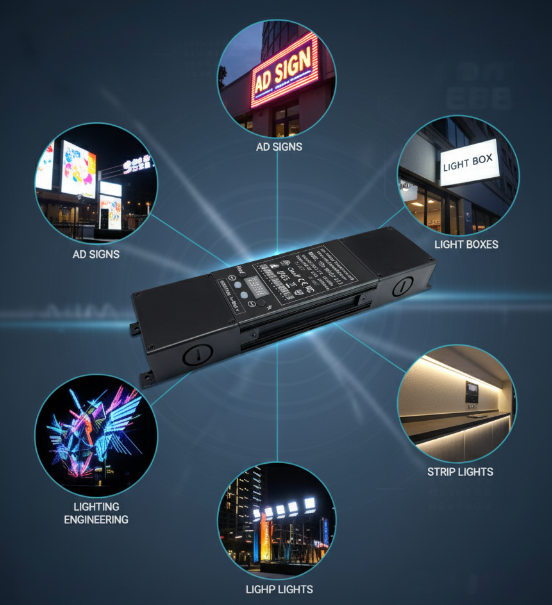
A properly rated LED strips outdoor power supply ensures consistent brightness across long cable runs and simplifies parallel wiring—critical for façades, courtyards, and architectural outlines.
2. Landscape Lighting with Multiple Fixtures
Landscape lighting systems often combine:
- Path lights
- Step lights
- Garden accents
These fixtures usually contain internal regulation and expect a stable voltage input. A landscape lighting driver with constant voltage output allows:
- Simple system expansion
- Balanced brightness across fixtures
- Easier fault isolation during maintenance
Constant current solutions in these systems often cause cascading failures.
3. Signage, Channel Letters, and Advertising Light Boxes
LED modules used in signage are standardized around constant voltage for one reason: reliability at scale.
A dedicated signage LED power supply provides:
- Uniform brightness across modules
- Stable startup in cold or humid environments
- Compatibility with global signage standards
This is why constant voltage remains the industry default for outdoor signage worldwide.
The Hidden Cost: Lifespan and Maintenance
Outdoor environments amplify stress factors—heat, moisture, voltage fluctuation, and surge events. Choosing the correct driver topology directly impacts service life.
Projects that combine constant voltage drivers with intelligent control strategies can dramatically reduce runtime stress and failure rates. Many professional installers now focus on ways to extend outdoor lighting lifespan with time-controlled drivers, especially for signage and landscape projects operating long hours.
👉 Internal link: extend outdoor lighting lifespan with time-controlled drivers
Why Many Outdoor Projects Still Choose the Wrong Driver
Common reasons include:
- Copying indoor driver specifications
- Selecting based on wattage only
- Underestimating voltage drop and parallel loads
The result is higher maintenance cost, unhappy end users, and shortened system life.
How to Select the Right Constant Voltage Driver for Outdoor Use
For projects that require waterproof construction and long-term outdoor stability, many installers choose a waterproof constant voltage LED driver for outdoor lighting as the base configuration, then adjust wattage and protection level according to site conditions.
Before finalizing a driver, verify:
- Output voltage accuracy (12V / 24V)
- IP rating suitable for installation (IP65–IP67)
- Surge protection level
- Power margin of at least 20%
A well-designed constant voltage LED driver outdoor lighting solution protects your project—not just your budget.
Industry References for Further Validation
- External reference: IEC 61347 LED driver safety standards and outdoor application guidelines – published by the International Electrotechnical Commission
- External reference: LED power supply selection best practices – technical guidance from Mean Well
Final Takeaway
If your outdoor project uses LED strips, signage modules, landscape fixtures, or advertising light boxes, constant voltage drivers are not just suitable—they are essential.
The right driver choice delivers:
- Stable light output
- Lower failure rates
- Reduced maintenance cost over the project lifetime
If you want fewer callbacks, fewer complaints, and longer-lasting outdoor lighting systems, start with the right driver architecture.
If you are currently working on an outdoor lighting project involving LED strips, signage, landscape fixtures, or light boxes, this is the right moment to confirm your driver architecture.
Before finalizing your order, make sure you can clearly answer:
- Are the LED loads designed for fixed voltage input?
- Will fixtures be connected in parallel or expanded later?
- Is maintenance access limited after installation?
- Does the project require long daily operating hours?
If your answer is “yes” to most of the above, a constant voltage driver is the safer and more scalable choice.
👉 Project support: Our team supports OEM and project-based outdoor lighting applications, including driver selection, power margin calculation, and protection-level matching.
Early confirmation at the driver stage helps avoid redesign, delays, and unnecessary maintenance cost later.